Quantifying Coffee Grinders
Status: completed
This article assumes you have already started nerding into Coffee. I have been looking into an upgrade of my coffee grinder. In this post, I'm going through my learnings of the relevant metrics. Writing this down helps me solidify my understanding of these concepts (hopefully). This is mostly a theoretical piece. I am no taste-bud reference and have not done comparative tasting of different grinders.
Starting out, what do I want from a grinder?
- It should fit into my life: Aesthetics, Footprint, Price, Noise.
- Its grounds should allow me to brew a consistent and delicious coffee.
- The workflow with it should be enjoyable: Grind Speed, Time it takes to get a dose, Dialing in, Switching between beans, Switching between brew methods.
In the first part, we'll go through how the grinder influences the taste of the coffee. The second part is about getting clarity on the cons of using a bean hopper, even with grind-by-weight.
Let's investigate the contributing aspects further.
Design Goal: What kind of ground coffee will taste nice?
We need to understand what we should actually optimize for. Particle Size Distribution (PSD) is the basis that
attempts to quantify grinder characteristics. That is, the distribution of coffee particles of different sizes. My naive
assumption was always that this is all about uniformity. My idea of an ideal grinder was one that crushes beans into
particles of equal size. The general idea is quite simple: all pieces are equally sized and can thus be equally
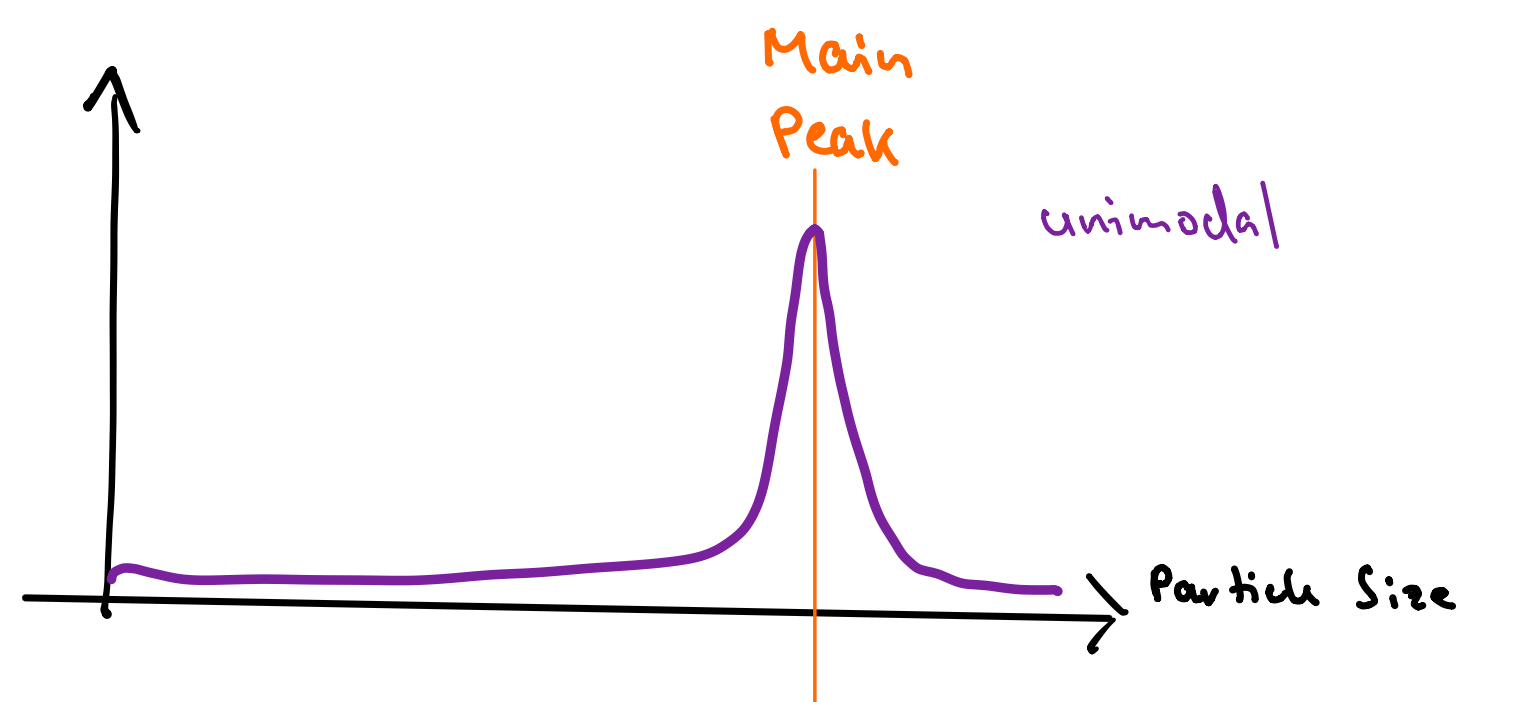
extracted at their sweet spot. I was surprised to see that this design target was only a rather recent thing. Unimodal burrs. The name hints at it; we have one mode (= one particle size) where most of our particles are.
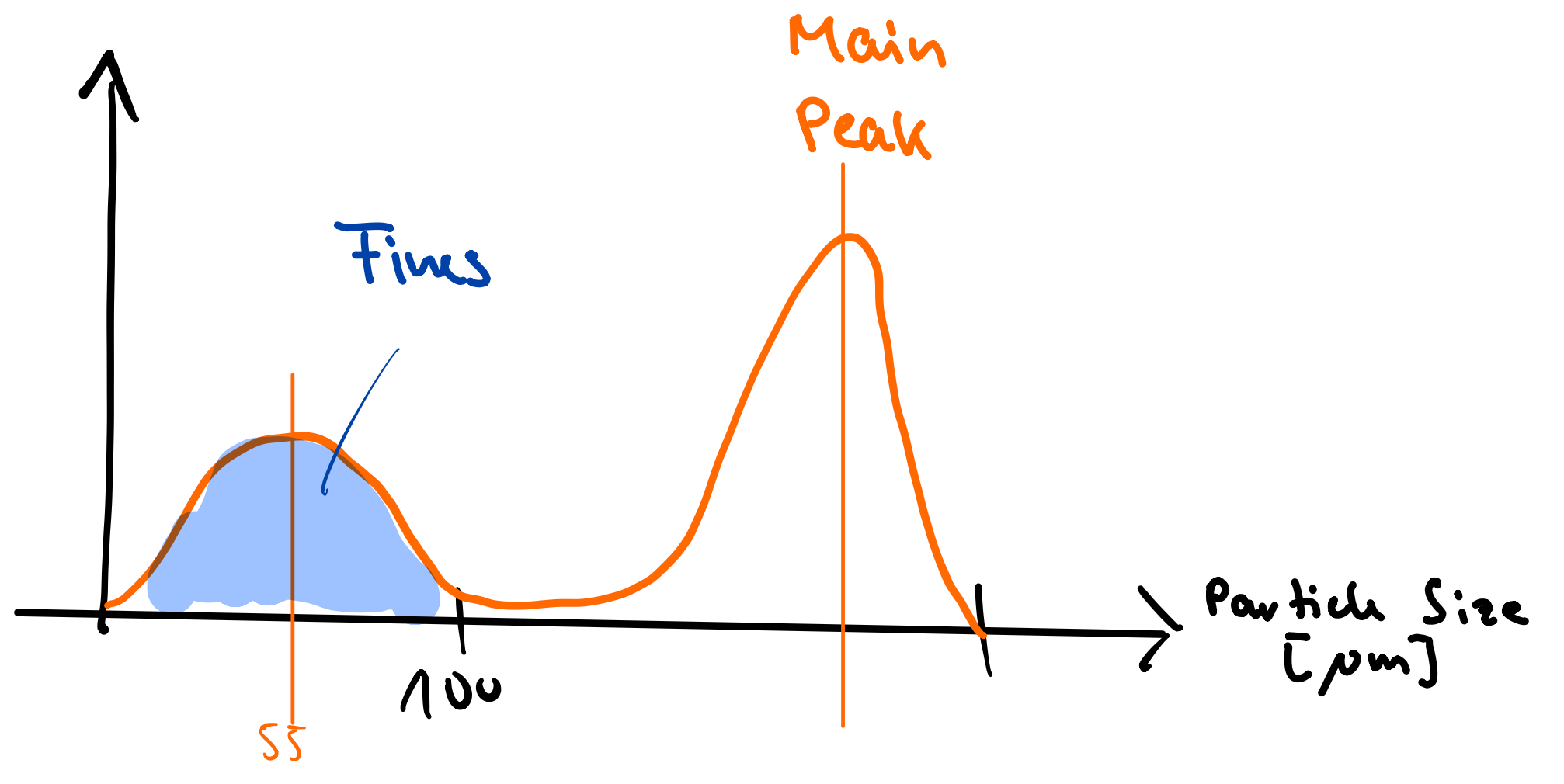
Traditionally, bimodal burrs were the norm and are still desirable due to a different design goal. The underlying idea is that we have a majority of particles of "medium" size. The remaining particles should be significantly smaller bits, "filling" the space between the larger particles. Their role is to increase the overall resistance of the coffee puck.
There are also discussions about whether multi-modal output (3+ distinct size peaks) would be desirable, though my impression was that this is still very experimental — which I am not the target audience for. We'll focus on the two distinct design goals discussed above.
Performance Quantification
How well the design goals are achieved can be quantified by measuring the output grounds. For unimodality, I assume this to be quite straightforward: a distinct, thin peak around one particle size, and that for all grind sizes.
Generally, most find unimodal PSD desirable for filter and immersion brewing. There can be flavor preferences for more "traditional" profiles with "strength". To me, that is not why one goes for filter coffee.
Quantifying the desireability of bimodality is more complex. While a narrow main peak is still key for even extraction, the "ideal" distribution of fines is less clear to me. Should they form one distinct secondary peak, or would we actually prefer them to spread over a broader spectrum as long as they stay far from the main peak?
The role of fines in espresso
Classic coffee machines ramp up to 9 bar and keep it there until the end of the shot. To achieve a balanced extraction, the puck must provide sufficient resistance. This resistance is largely due to the fines with the bimodal PSD. A unimodal PSD can reach the required resistance as well by grinding significantly finer than the main peak from the bimodal PSD. However, it is harder to hit that sweet spot without channeling. The fines leave a broader window to operate within. It would also help if the machine were able to run at a lower pressure (like 6 bar), which most machines today cannot be configured to.
Bimodal ground espresso is described as having "more body" and "creaminess". My understanding is that this comes from fines that are small enough to pass through the basket holes. These tend to stabilize coffee oils together, which is what we perceive as more "syrupy".
On the other hand, unimodal PSD is said to provide "clarity". There is no over-extraction of the fines. This over-extraction tends to come with some bitterness, which disturbs said clarity. Bitterness is inherently not a bad thing but a matter of taste. Having it in the cup might dominate or numb other flavors, though.
Higher amounts of fines allow and require coarser grind settings, have "more body", and less nuanced taste profiles.
The holes in the portafilter baskets are around 200-300
Permeability: Measure of how well fluids can flow through a medium
There is Darcy's Law which—applied here—describes the flow rate
Overall, the only metric for small particles metric I am interpreting is the accumulated percentage of fines in the PSD. This is not directly a quality metric but gives an indication of how strongly a grinder leans into the traditional, "body" espresso. How much a distinct/clear main peak can compensate, I don't know.
Let's put some numbers to it. An example
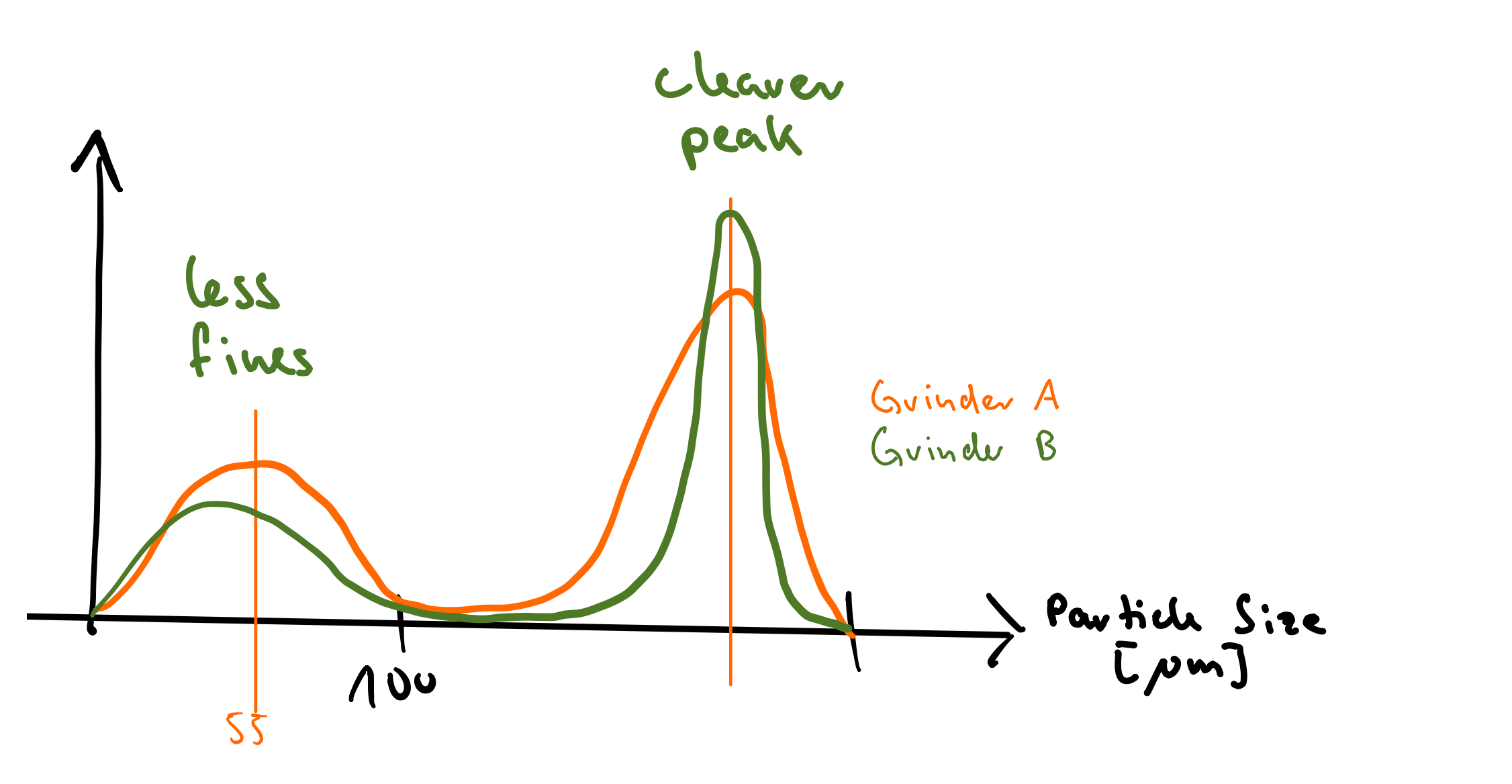
Let's go into two simplified PSDs. They show two grinders with a dialed-in espresso.
 When it comes to the taste of the coffee, all elements are interconnected. A separation of the elements does not fully
work, but it can be a helpful mental concept to understand individual contributions.
When it comes to the taste of the coffee, all elements are interconnected. A separation of the elements does not fully
work, but it can be a helpful mental concept to understand individual contributions.
- In the chart, we have the fines peak at
for Grinder A and a bit lower for Grinder B. This influences the permeability and thus the puck resistance. How exactly is not clear to me. - The integral of the fines
is smaller for grinder B. Relative to grinder A, it has "less body" and produces a more nuanced shot. I am not sure whether it is harder to dial in. - The clearer main peak helps pronounce the coffee better. More particles can be extracted at their sweet spot.
- Both grinders have their main spike at the same spot. I am not aware that anything can be derived from peak value differences. The peaks shift with grind size adjustments.
My Desire
While I enjoy nerding out on coffee occasionally, in my day-to-day I prefer a quickly dialed-in coffee and usually want the process to just work™. I think I prefer the expressive coffee notes (found with more clarity) over the more bitter aspects, but don't dislike them either.
My current machine is a quite basic beginner model (Sage Bambino Plus) with a flat 9-bar pressure profile. I worry about not having enough controllable process parameters to pull reliable shots with changing beans. A unimodal PSD will require a significantly smaller grind size due to the absence of fines. If I knew I could do that reliably and relatively hassle-free on a day-to-day basis, I'd opt for unimodal. But I believe that not to be the case.
This leaves me deciding between different kinds of bimodal burrs. In the discussed example above, my choice would then be grinder B.
I want my next grinder to last at least 10 years. It thus needs to provide a platform that allows exchanging the burrs in the future.
We left out quite a few interesting aspects here. I am not questioning whether flat burrs are really better than
conical ones. I think they are, based purely on their prevalence in high-end grinders.
The size of the burrs is not mentioned. Overall, I believe that bigger burrs have a higher quality ceiling than smaller ones.
The discussion is mostly relevant for lighter roasts. I think it is an antithesis to have dark roasts with a unimodal burrset.
Lastly, the precision of the alignment of the two burr parts is fundamental for every grinder. Imperfections there will have an impact on the PSD.
Workflow
I needed to get clarity on the impact of a hopper in the workflow.
Retention
Let's start by defining retention
A clean machine has no coffee inside yet. We expect the first shot to be negative, say
This brings us to the part that I believe to be worse: the amount of coffee staying in the grinder and coming out with the next grind. This could be stale coffee from 3 days ago (if we have not used the machine over the weekend) or ground coffee from a different brewing method before.
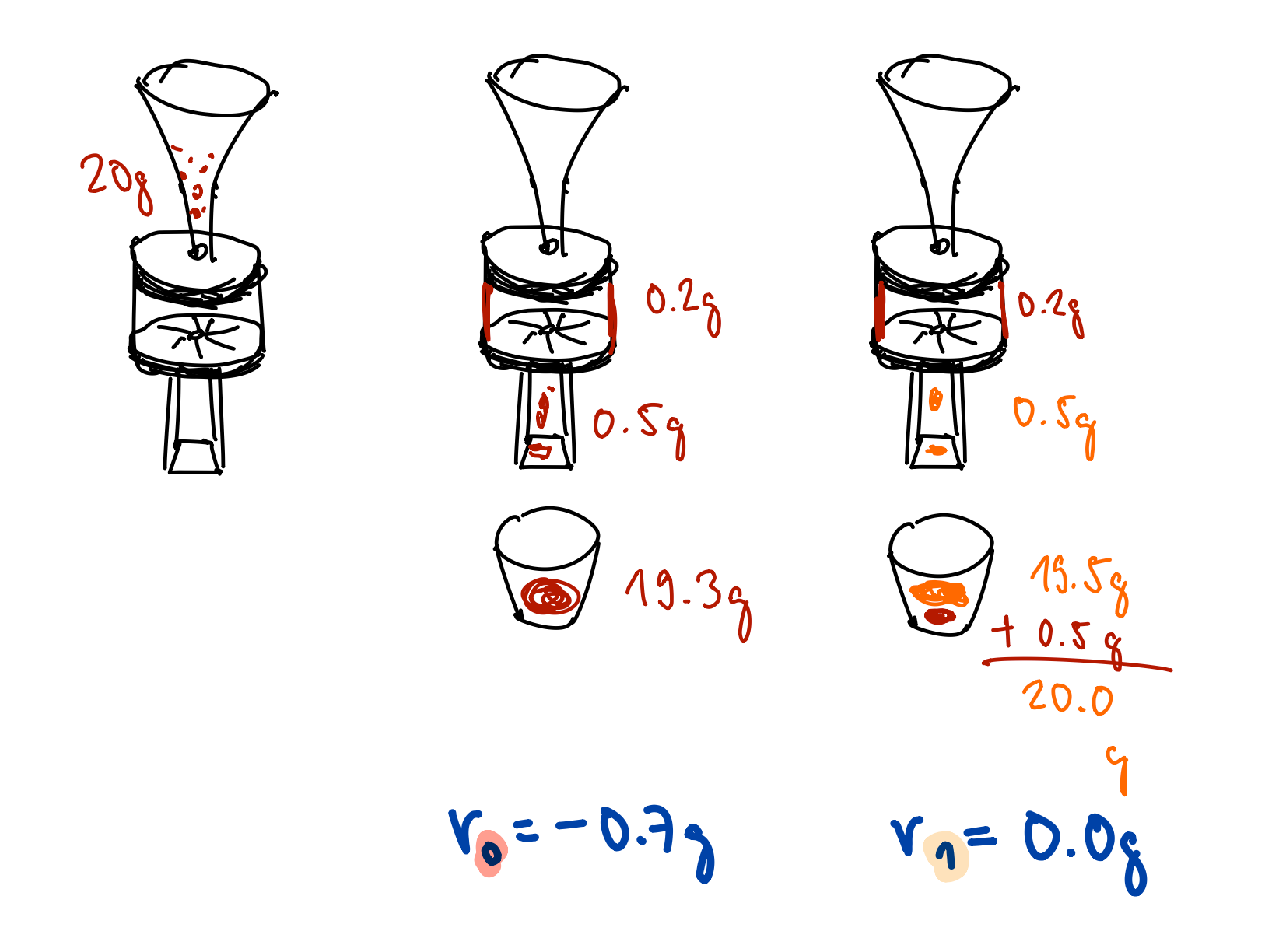
I propose we name the two types of retention:
- Fixed retention: coffee stuck in the grinder but not moving.
- Exchanged retention: coffee that leaves the grinder in a subsequent dose.
Measuring
How do we measure the two?
I would imagine the fixed retention to slowly build up in reality. Measuring it should be easy: clean the grinder thoroughly after some usage, and measure all coffee you cleaned out of the machine.
Exchanged retention is likely more nuanced. We could color the beans for each dose and see how much of the last color comes out? This might already work when swapping from light to dark roast.
One can also measure the weight consistency. What variance do our retention measurements
Does exchanged retention even matter?
The interest or almost obsession with retention is a newer thing with the rise of home baristas. In an industrial setting, a grinder gets dialed in and pulls likely a few hundred shots with the same coffee bean and grind size. The included exchanged retention will still be fresh and of the same target size.
My use case is different. There are stretches of days without me making a coffee at home, meaning the first shot after this period would contain old coffee. Or I might want to do a filter coffee in the morning and have an espresso after lunch. Filter-sized grounds should not land in the portafilter. Both issues can be mitigated by purging the estimated exchanged retention before working on the new coffee.
While my taste buds are less refined than James Hoffmann's, a one-day staling of ground beans is already clearly noticeable to him.
Single-Dosing vs Grind-By-Weight
So far, we assumed pre-weighting the beans before every shot. Coffee hoppers aim to speed up that workflow. We can time how long we rotate the burrs and use that as a dosing proxy. This is quite consistent in an established recipe, but falls short as soon as we change the grind size or beans. Coarser grind settings will produce more coffee in the same time interval.
Grind-By-Weight addresses this issue by directly measuring the amount of coffee at the output and introducing a smarter control-loop. Overall, that's pretty cool and handy.
My issue with both of those methods is that for both of them to work we need a continuous stream of coffee beans as input. This comes with significantly more exchanged retention. Some of the exchanged retention is in a half-crushed bean state - the ones that were just in between the burrs when the control-loop stops the motor.
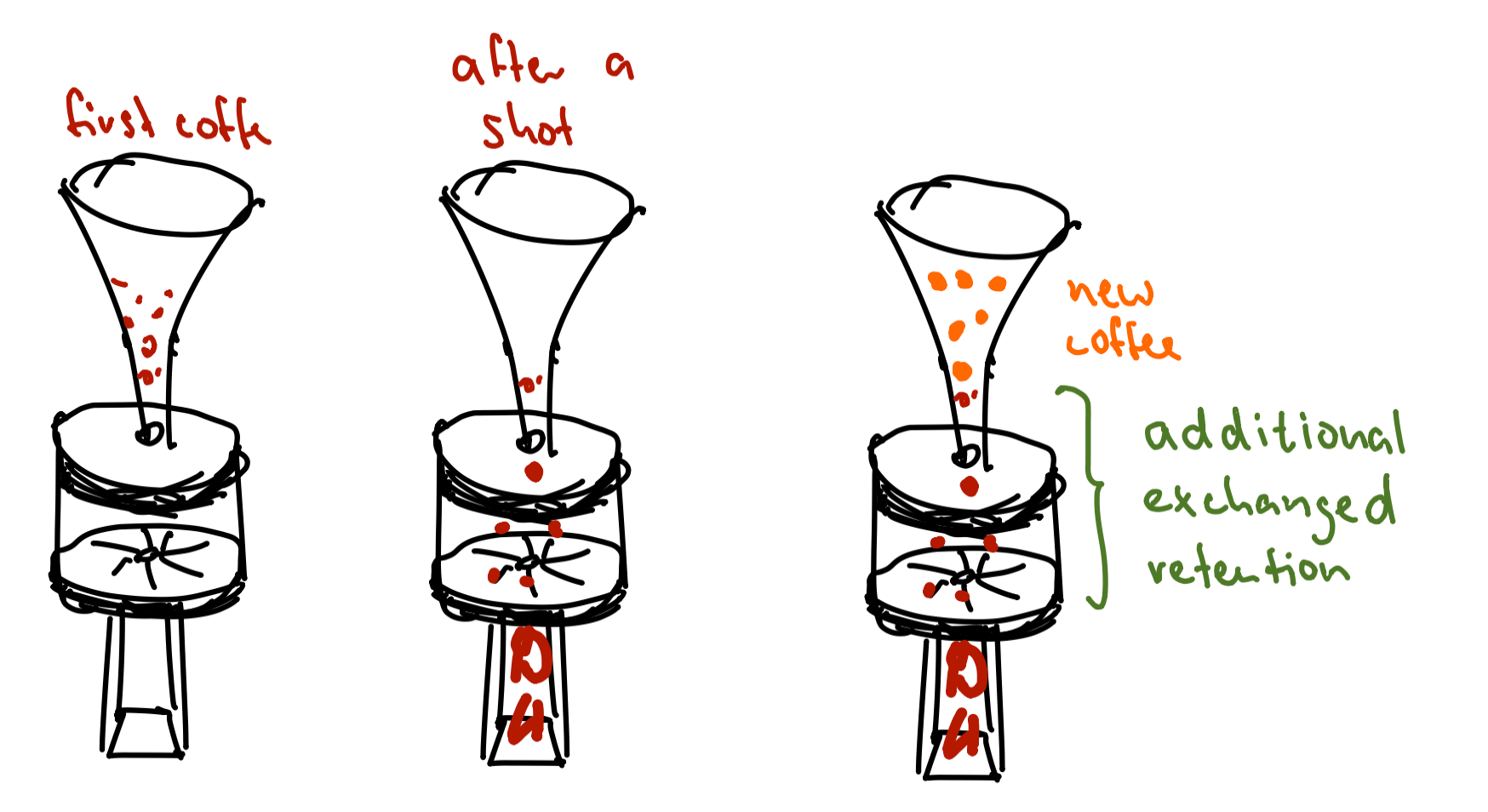
Again, we can mitigate this by purging more or, alternatively, just embracing the "Frankenstein Shots" (shots containing a mix of previous and new dose). To dial in espresso, I would switch to single dosing until the right setting is found, then set the target time/weight that matches the determined recipe.
I currently have a grinder with a hopper and grind-by-time. I started using it as a single-dose hopper. Overall, I find pre-weighting the beans less cumbersome than I expected. I currently have a dedicated hand grinder for filter coffee. My next grinder should be able to handle both filter and espresso. In that scenario, single-dosing seems more convenient to me.
Wrapping it up
I am looking for a single-dose grinder with low exchanged retention. While dialed-in uniform burrs likely would match my taste preference, I don't trust them to be hassle-free enough on my flat 9-bar coffee machine.